
A 42-year-old man, identified as Lobga Rangzen, died after setting himself on fire outside the United Nations headquarters in Manhattan. The act was an apparent protest, with a Tibetan flag and a 'CHINA OUT OF TIBET' slogan found at the scene, linking it to the ongoing Tibetan Independence Movement.
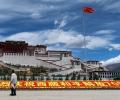
National security, consolidation of border defences and border security highlights China's Tibet policy, points out Jayadeva Ranade, the former senior RA&W officer and China expert.
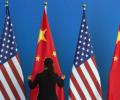
Secretary of State Mike Pompeo said he was taking action against an unspecified number of Chinese officials, including from the ruling Communist Party, under a US law that calls on China to let Americans visit Tibet.

A village built by China along the Line of Actual Control in the Arunachal Pradesh sector and mentioned in a recent Pentagon report, is in territory controlled by that country, sources in the security establishment in New Delhi said on Tuesday.
The Tibetan government-in-exile and China are continuing to hold back-channel talks and the last round took place this month, just days before US President Joe Biden signed a legislation that seeks to press Beijing for a negotiated settlement to Tibet's demands for greater autonomy.
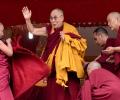
China is acutely conscious of the need for the next Dalai Lama to be under its control. It was for this reason that China recently stressed their claim on Arunachal Pradesh. There were rumours that the next Dalai Lama may be found in Tawang. If that happens, India-China relations will become tense and there may be demands for the child to be handed over to the Chinese, points out Ambassador T P Sreenivasan.

"So far Tibet is concerned, our position has all along been that the issue has to be resolved between different sections of the people of Tibet and People's Republic of China through dialogue and not through force," he said during an interaction with journalists at an orientation programme on Parliamentary reporting.
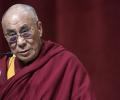
China is worried about the situation post the Dalai Lama and that his reincarnation could surface in Arunchal Pradesh, a region it claims as its own, but which is part of the Indian Republic, says former RA&W Additional Secretary Jayadeva Ranade.

The Tibetan nation still lives under the yoke of the Chinese Communist Party, and Beijing today has a guilty conscience; this creates a great uneasiness for Xi Jinping and his colleagues observes Claude Arpi.
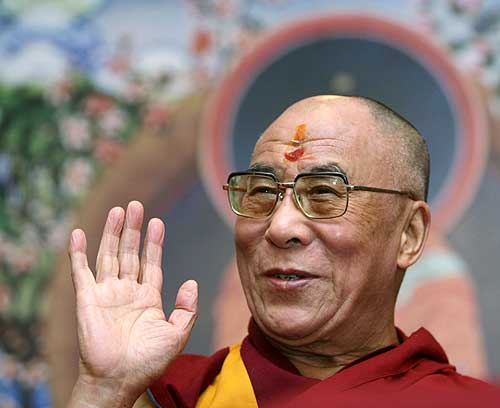
'The first time that China alleged the Dalai Lama was 'anti-national' and 'unpatriotic' was after he affirmed that Arunachal Pradesh and Tawang are part of India,' points out former RA&W official Jayadeva Ranade.

'Tibet remains a prickly issue between the giant Asian nations. China still claims more than 80,000 sq kilometres of Indian territory in the Northeast. Why? Just because Beijing refuses to acknowledge the McMahon line which separates India and Tibet, and this, simply because the 1914 Agreement delineating the border was signed by the then government of independent Tibet with India's then foreign secretary (Sir Henry McMahon),' says Claude Arpi.

All that India must aim for is to match China's military prowess adjusted to equal Beijing's India-specific military capability, argues Vivek Gumaste.
Currently, the reserve forces are under the dual leadership of military organs and local Communist Party committees and they would be brought under the control of the ruling party and the CMC from July 1, the state-run Xinhua news agency reported.

Why is China's supreme leader promoting Han Chauvinism so aggressively, asks Claude Arpi.

China has been taking "incremental and tactical actions" to press its claims at the Line of Actual Control (LAC) with India and has unsuccessfully sought to prevent New Delhi from deepening its relationship with the US during and subsequent to the standoff, the Pentagon has said in a major report on China's military modernisation.

Xi has called on Chinese border troops to enhance their capabilities in border defence and control to forge a "great wall of steel" along the country's borders, it said.

'Tibetans will participate in future conflicts with India (in all probability, some were already present in Galwan).' 'As nobody in India would like to have a deadly fight with Tibetan soldiers and officers, the issue needs to be closely followed,' observes Claude Arpi.

'China is concerned about its impact within Tibet.'

China is spending billions of dollars to improve infrastructure in Tibet and other parts of its border with India. Claude Arpi explains why New Delhi can't afford to ignore Beijing's plans.
After the Ladakh fiasco where Xi Jinping did not expect the Indian Army to resist his land-grabbing tactics, he has to save face before his colleagues in the Communist party.' To bring the threat of a mega-dam to the northern Indian border is a clever move, observes Claude Arpi.
China has chosen to keep New Delhi guessing, while retaining for itself the option of constantly changing facts on the ground and shifting the LAC westwards -- the strategy called 'salami slicing', notes Ajai Shukla.

Important for India was Xi's meeting with representatives of PLA officers and soldiers stationed in Tibet. The video of the encounter was interesting to watch, especially the large number of lieutenant generals and major generals, observes Claude Arpi.

'Chinese troops are not geared to fight Indian troops who are battle hardened and acclimatised and are far more hardy.'
With the continuing stand-off in Ladakh casting a shadow over the Sino-India talks, Prime Minister Narendra Modi on Thursday raised 'serious concerns' over the repeated incidents along the border and sought an early settlement of the boundary question.

'The intrusion in Chumar, during and beyond the Chinese president's visit, is unprecedented and has qualitatively changed the tone of the India-China relationship,' says Jayadeva Ranade, a member of the National Security Advisory Board.

'Lhasa is more than the Unesco World Heritage Sites it boasts of. It is more than a gateway to the mighty Himalayas.' 'It is about the warmth of its people: Unsaid, unspoken, but felt everywhere,' discovers Shruti Bajpai.

'If, as appears to be the case, India is on way to 'mending fences' with China, and China is equally desirous to 'reset' the relationship, this could be a self-reflexive moment in India's positioning vis-a-vis not just the Dalai Lama, but also the Tibetan issue and China as a whole,' points out China expert Alka Acharya.

'J&K continues to have the highest concentration of military personnel anywhere in the world and the alienation of the Kashmiri has increased in the last ten years than ever before.'
